Decumulate & Downsize

Most of your investing life you and your adviser (if you have one) are focused on wealth accumulation. But, we tend to forget, eventually the whole idea of this long process of delayed gratification is to actually spend this money! That’s decumulation as opposed to wealth accumulation. This stage may also involve downsizing from larger homes to smaller ones or condos, moving to the country or otherwise simplifying your life and jettisoning possessions that may tie you down.

Can you Pursue Financial Independence without giving up Travel?

By Devin Partida

Special to Financial Independence Hub

The Financial Independence, Retire Early [FIRE] movement has gained awareness and popularity. It’s commonly believed that to achieve this highly-sought-after goal, young adults must live an immensely frugal life, guided by constraints and a “suffer now, enjoy later” mentality that results in the restriction of leisure like traveling. However, maintaining Financial Independence while traveling is entirely possible with a proper strategy.

The Perceived Conflict of Financial Independence vs. Travel

Findependence Hub CFO Jon Chevreau and his wife Ruth avoided some of Canada’s harsh winter by living (and doing a little work) in Malta. Here are the island’s famed colourful boats.

People often feel that travelling can drain budgets and delay retirement. This mindset comes from the perception that travel entails expensive hotels, premium flights and fancy dinners. Instead, try viewing travel as an investment in your well-being and growth.

As enjoyable as exploring new locations and sightseeing are, the heart of travelling is much deeper. Stimulating the brain in new ways can release chemicals like serotonin, lower cortisol levels and improve cognitive thinking skills.

Traveling offers opportunities to broaden perspectives and engage in self-discovery, which is far more valuable than a weekend at a 5-star hotel. By aligning your travels with core financial values, it becomes sustainable and a solid return on investment.

Strategies for Reducing Travel Expenses

Cutting down on travel costs starts with budgeting. Before you even board a flight, you should have decided how much you’re willing to spend on your trip, which is something that differs from person to person based on personal goals and circumstances. Establishing a strict daily budget provides the data required to adjust spending patterns in real time.

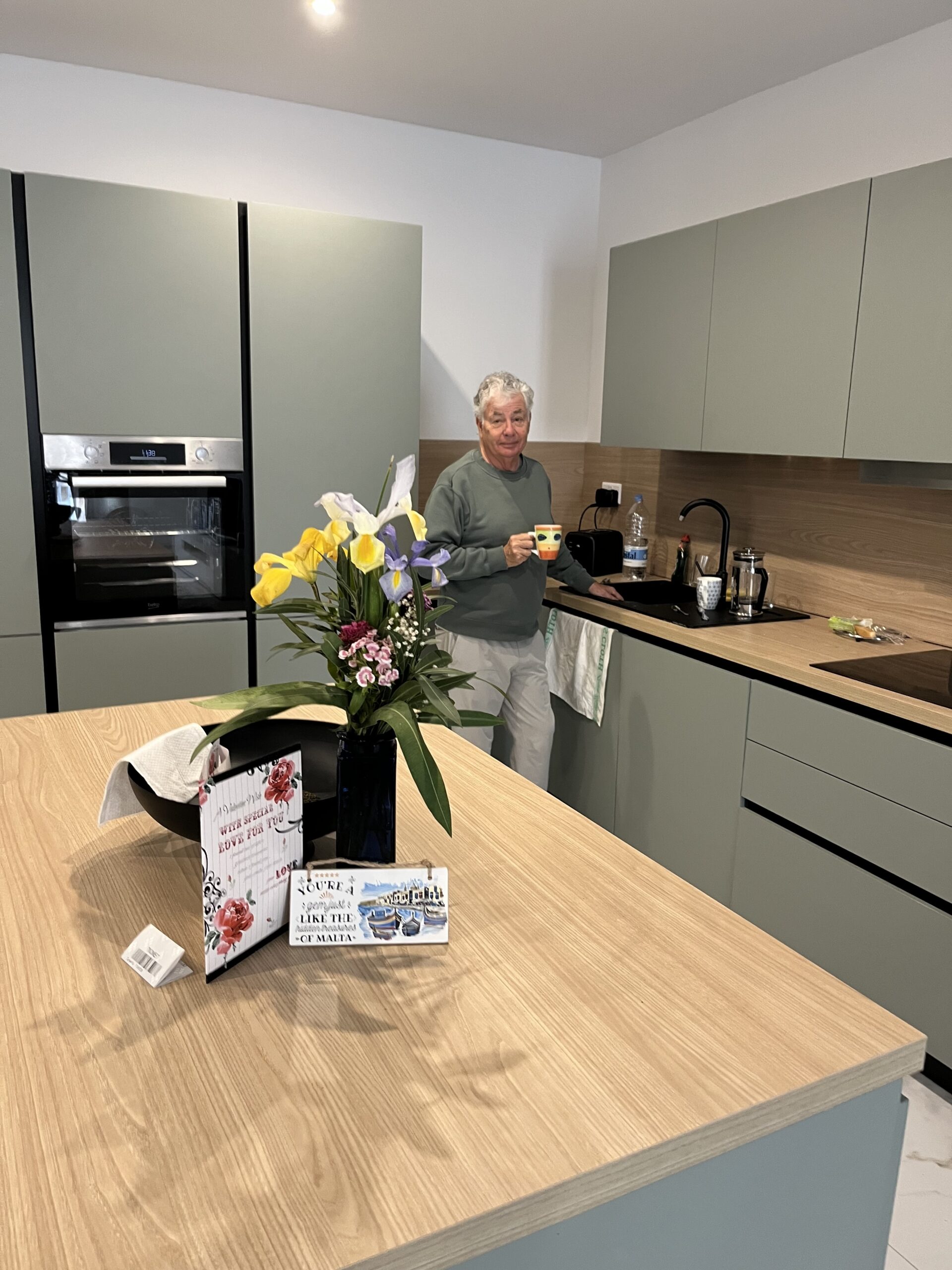
Jon & Ruth spent February in this AirBnB in Malta. Rates are lower when you commit to a whole month. Save more eating in with a fully equipped kitchen.

Implementing discipline in your travel spending prevents minor costs from eroding an investment portfolio over the long term. Primary strategies for minimizing the three largest travel expenses include:

  • Alternative accommodations: Choosing alternative lodging accommodations has become a popular way of reducing traveling costs. Notable options are house sitting, pet sitting and hostels. Alternatively, volunteering opportunities often provide free accommodation.
  • Off-season transit: Booking flights and transit during the off-season is a great way to reduce costs without compromising the quality of the experience. Booking flights months in advance often results in lower
  • Local logistics: Prioritize local transit systems and walking over private rentals or ride-sharing services.

Generating Income while Travelling

Building capital, whether actively or passively, is another great way to achieve Financial Independence while travelling. An increasingly popular option is through professional mobility or remote work. Individuals in fields like software development, design and consulting can continue to work and maintain consistent earnings regardless of location.

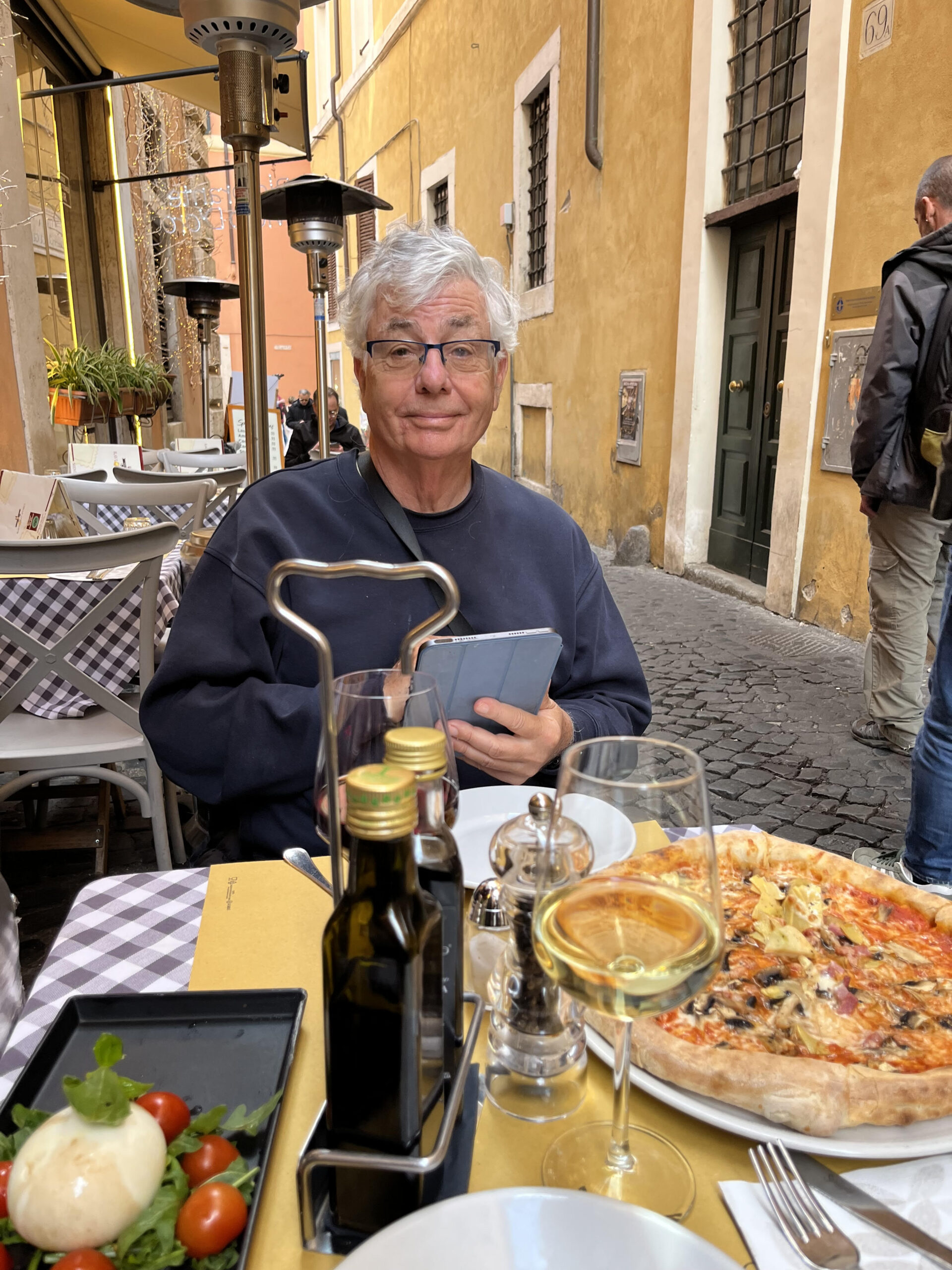
Jon Chevreau doing a little work over lunch in Rome last week, taking advantage of a restaurant’s free wi-fi to promote the site’s latest blog.

In addition to having a location-independent business, finding passive income streams is a great way to earn while traveling. In today’s digital age, people can start an e-commerce business on their phones, enabling them to be anywhere in the world and still maintain a steady flow of capital.

For those who aren’t entrepreneurial, investing to generate passive income is a great alternative. Even if you don’t have a finance degree, there are plenty of resources online regarding simple and safe long-term investing strategies. These could include ETFs, dividends or real estate.

Being a digital nomad has become a highly desirable aim for many professionals in the modern age. The key to this approach succeeding is finding a way to balance fun and productivity while traveling, and setting the right boundaries where necessary.

Achieving Financial Independence while Travelling

Balancing financial freedom with travel is a matter of strategic design rather than sacrifice. The key to achieving longevity is letting go of extremes, finding balance in long-term health planning and collecting life experiences. By prioritizing mindful choices, it is possible to build a life of liberty that begins today, not in a few decades.

Devin Partida is the Editor-in-Chief of ReHack.com, and a personal finance writer. Though she is interested in all kinds of topics, she has steadily increased her knowledge of the intersection of finance and technology. Devin’s work has been featured on Entrepreneur, Due and Nasdaq.

Make the most of House Sitting

By Billy and Akaisha Kaderli, RetireEarlyLifestyle.com

Special to Financial Independence Hub

Interview with Lori and Randy Grant, Professional House Sitters  

Many people would like to know more about house sitting — the ins and outs, what to expect, how to get started, and if it’s really feasible to do house sitting as a lifestyle.

Lori and Randy Grant, professional house sitters, were more than generous with their time in answering our questions, and in providing photos and a couple of house sitting stories at the end of this interview.

If you would like to try house sitting, take advantage of what Randy and Lori know.

Enjoy our interview!

Randy and Lori enjoying a side trip to Santorini, Greece between house sits

Retire Early Lifestyle: Could you tell us a little bit about yourselves and why you decided to do some house sitting in your retirement?

Lori and Randy Grant: Randy and I are former teachers whose careers took us overseas to Japan for sixteen years, where we taught U.S. military dependents at the high school level. After our son, Chase, left Japan to go to college in Florida, we started thinking about making our own exit. At first, it was just daydreaming about being location independent, financially independent, and doing whatever brings us joy every day. Finally, we took the big leap, started selling everything we owned, and accepted an early retirement incentive package from our teaching careers in 2014. It was a slightly terrifying, but mostly exhilarating experience to jettison ourselves to complete freedom.

Our first year in early retirement was spent exploring Thailand’s culture and language. We really took that time to settle into our new lifestyle, and there were a few ups and downs for me. I lost my daily structure that teaching brought me, so I struggled to find a new routine to my days. That’s where house and pet sitting became a good fit for us. We started out by just being asked to watch family and friends’ houses and pets while they went away on vacation. Soon, we found that the word-of-mouth about us was filling our calendar with sits all over the place! We eventually joined an online house and pet sitting site and put a profile online advertising our services, which are free, to a worldwide database of homeowners looking for the perfect sitters.

Retire Early Lifestyle: How long have you and Randy have been house sitting as a way to enhance your retirement and travel?

Lori and Randy Grant: We have been doing this off and on for approximately five years.

Retire Early Lifestyle: Could you tell our readers how you work this to your benefit? Lori and Randy Grant:

Since lodging is one of the biggest expenses as we travel, this is a great way to cut that major cost. House and pet sitting is a free service. We trade out for free rent and utilities in the home where we stay. Another added benefit is that since we are in an area longer than just a few days, we get to explore the area more in depth. We actually feel like part of a neighborhood! We really believe that pet sitting is a win-win situation for all involved because pet owners get to keep their pets in their own environment rather than facing the stress and expense of kenneling them.

Randy enjoying a neighborhood in winter

Retire Early Lifestyle: Would you recommend house sitting as a lifestyle or as a way to reduce housing costs in retirement?

Lori and Randy Grant: Absolutely! The money you save in rent can then be used for something else.

Retire Early Lifestyle: Can a single house sit? How about a single woman? Is it harder for a single to house sit?

Lori and Randy Grant: We don’t think it matters as long as you are a fit for what the homeowners are looking for. Some applications will request either a couple or a single person if they have a specific preference. You might also see a request for non-smokers or people who are willing to spend most of their time at home with the pets, rather than those who are interested more in sightseeing around the area.

Randy brushing Calvin after a walk during a pet sit in Bellingham, WA

Retire Early Lifestyle: What if I want to house sit in a foreign country but don’t speak the language?

Lori and Randy Grant: It could potentially be an issue; however, it usually depends on the owner. We had a house sit that we applied for in Venice, Italy and we weren’t selected for it because the owner wanted someone who spoke Italian. These days, we have no qualms about house sitting in a country where we don’t speak the language. Google Translate Online is our main form of communication in cases where we are not familiar with the language. That, and we always manage to meet up with other English speakers wherever we roam.

Retire Early Lifestyle: What does a House Sitter do?

Lori and Randy Grant: Usually an owner will leave specific instructions on how they want their home and pet cared for and what things need to be taken care of in their absence. Our main priority is the pet’s needs such as their feeding, exercise, and daily routine. After that, we focus on keeping the home tidy and well maintained, the yard or garden spruced up,  as well as the trash and recycling disposed of properly. The remainder of the time we do whatever we want such as hiking, yoga, cooking, and exploring the local area.

Besides pet sitting, we are also sometimes responsible for keeping yards and pools maintained

Retire Early Lifestyle: How do I get started? Do I have to join a house sitting organization?

Lori and Randy Grant: We started out with just doing favors for friends and family by watching their home and pets. Then, from that experience we built a house and pet sitting profile online that included recommendations from homeowners whom we’d sat for previously. Finally, as we came to the realization that we really enjoyed house and pet sitting regularly, we joined a house sitting site online to get more worldwide exposure.

Retire Early Lifestyle: How do I interview for a house sit?

Lori and Randy Grant: The first thing to do is apply for the house sit on whatever forum you choose such as a Facebook site, an online house sitting site, or via a community message board. Owners will then look over your profile to determine if you are a good match. If you are on their ‘short list’ (one of their top three applicants), you may be asked to interview over the phone or video chat through Skype. This gives the owners and sitters an opportunity to meet face to face. It also gives you the ability to see the pets and have a look at the house. After your video chat/interview, wait for the owners to contact you that you’ve either been selected or they have chosen other sitters. If you’re selected, you then begin a regular conversation so that you can ask questions, share your travel plans to their home and get more detailed information about their pet’s needs.

Making new four-legged friends on the malecon in Ajijic, Mexico

Retire Early Lifestyle: How much should I charge for house sitting?

Lori and Randy Grant: We do not charge for our services. It is an even exchange of pet sitting for free lodging.

Retire Early Lifestyle: Is house sitting safe?

Lori and Randy Grant: We have always felt safe with our house sits, but remember to always do your research before agreeing to a sit. Look at the area where the sit is located and talk to the owners about the neighborhood, as well as the home’s specific security measures.

Retire Early Lifestyle: Do you require anything from the homeowner when you take a house sitting job?

Lori and Randy Grant: We have a list of questions we ask about the pet’s daily routine and anything we need to know about how things run in the house. We don’t require anything specific, other than good wifi.
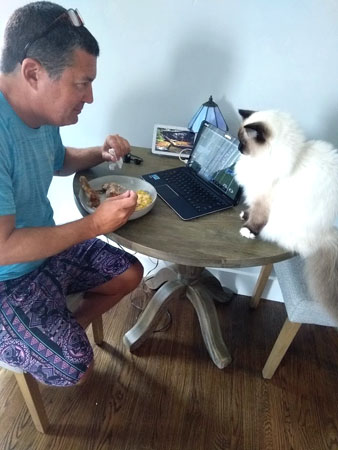
Randy and Fawkes having a staring contest during a pet sit in San Francisco, CA

Retire Early Lifestyle: How do you choose one sit over another?

Lori and Randy Grant: We usually look at the area where we most want to travel and if the sit coincides with the dates that we will be in that area. We also prefer sits that are not too isolated or in very remote, rural areas. We tend to choose sits that are more town/city centered so that there are more options for things to do.

Retire Early Lifestyle: What do you look for when you are wanting to find a house sit in a certain location?

Lori and Randy Grant: We look for the length of the sit mostly. We prefer the longer sits (over two weeks long) if we can get them. If we are constantly traveling to lots of different short term sits, then it becomes cost prohibitive for us regarding our transportation expenses.
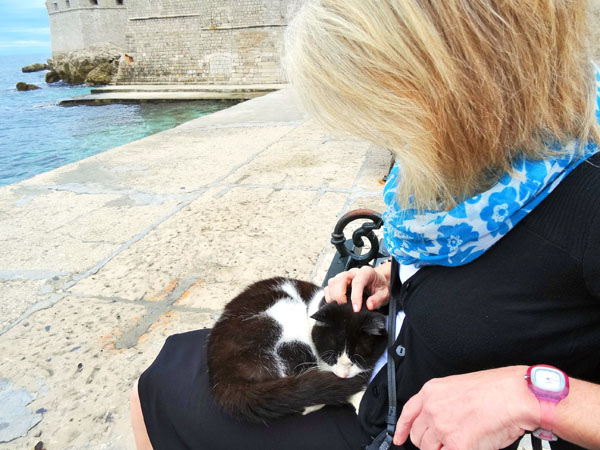
Lori is a warm lap for a stray kitty in Dubrovnik, Croatia

Retire Early Lifestyle: Do I have to pay my own travel expenses?

Lori and Randy Grant: Yes. It would be extremely rare to find a sit where the homeowners agreed to pay for a sitter’s travel expenses. However, many homeowners have offered to pick us up from the airport or train station when we arrive, which is a very nice gesture.

Retire Early Lifestyle: Can I find popular destinations like Hawaii or Paris?

Lori and Randy Grant: Absolutely, but apply early, as those sits tend to have many applicants vying for them.

Retire Early Lifestyle: Can I travel the world by house sitting?

Lori and Randy Grant: Sure you can. We are doing it!
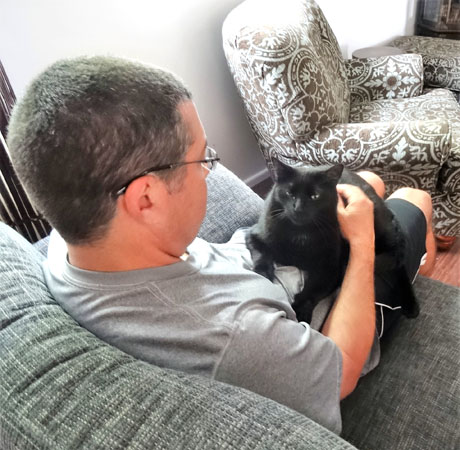
Randy introducing himself to Flash in Kaiserlautern, Germany

Retire Early Lifestyle: Can house sitting help me avoid paying rent? Can I do this all year round? Where do I go between house sits? Continue Reading…


Why Cash Flow Management is the Key to Early Retirement

Image by Pexels: Tima Miroshnchenko

By Kylie Ann Martin

Special to Financial Independence Hub

The dream of retiring early is no longer a niche pursuit reserved for the ultra-wealthy. Thanks to the Financial Independence, Retire Early (FIRE) movement, thousands of professionals are restructuring their lives to exit the traditional workforce decades ahead of schedule.However, many aspiring retirees focus exclusively on their “magic number” — the total net worth required to stop working.

While having a significant nest egg is crucial, the true engine of a sustainable early retirement is not the size of the pile, but the efficiency of the flow.

Early retirees must plan for 40 to 60 years of living expenses, navigating market swings, inflation, and longevity risk. A smart strategy for tracking, adjusting, and optimizing income and withdrawals is what keeps your portfolio lasting — and your freedom intact — long after you leave the traditional workforce.

The Shift from Accumulation to Distribution

For the majority of an individual’s career, the focus is on Accumulation. You earn a salary, minimize expenses, and invest the surplus into growth-oriented assets. The upward trajectory of your net worth measures success.

The moment you retire early, the game changes entirely. You move into the Distribution phase, where the primary objective is no longer growth at all costs, but the consistent generation of liquidity to fund your lifestyle.

The challenge of early retirement is that your assets must serve two masters: they must provide enough cash for today’s bills while continuing to grow enough to outpace inflation for the next half-century. This transition requires a psychological and mechanical shift.

You are no longer “saving” for the future; you are managing a private endowment where the “yield” must be carefully harvested without killing the “golden goose.” Learning how to balance your inflows and outflows effectively is the first step in making this mental leap from a steady paycheque to self-funded sustainability.

Managing the Sequence-of-Returns Risk

One of the most significant threats to early retirement is “Sequence of Returns risk,”which is the danger that the stock market will experience a major downturn in the first few years of your retirement.

If you are forced to sell stocks to pay for living expenses when the market is down 20%, you are effectively locking in those losses and depleting your principal at an accelerated rate.

Effective cash flow management mitigates this risk by ensuring you never have to sell equities during a bear market. You can achieve it through a “bucket strategy” or a cash buffer. Many financial experts suggest streamlining your liquid assets by keeping two to three years’ worth of living expenses in low-volatility accounts.

When the market is up, you replenish the cash bucket from your gains; when it is down, you live off the cash and give your portfolio time to recover.

Strategies to Make your Money Last

To thrive over a 40-year retirement horizon, you need a dynamic withdrawal strategy. Rigidly adhering to a “4% rule” may not be enough if inflation spikes or market conditions remain stagnant for a decade.

A proactive approach to spending in retirement involves creating “guardrails”—predefined rules that dictate when you should belt-tighten and when you can afford a luxury purchase.

Dynamic spending adjustments

Instead of withdrawing a fixed amount adjusted for inflation, dynamic spending allows you to reduce your “paycheck” during market dips. This preservation of capital during downturns is one of the most effective ways to extend the life of a portfolio.

The role of yield-producing assets

Diversifying into assets that provide natural income — such as real estate or dividend-paying stocks — helps bridge the gap between your needs and your portfolio’s growth. This reduces the friction of selling assets and provides a more predictable monthly floor for your budget. Continue Reading…

Vanguard is cautious on behalf of Retirees

Image coutesy MoneySense/Freepik

My latest MoneySense Retired Money column has just been published. Click on hypertext for full column: Why Vanguard’s ETF aimed at retirees is currently cautious in its asset allocation.

The column originated from a mid-January Vanguard Canada briefing with two of its economists held for the Canadian media in downtown Toronto. You can find at least two news stories on the web filed shortly after the event by Bloomberg News and Investment Executive.

While the general thrust of the press conference was on the opportunities for Canada in A.I. and materials stocks (chiefly gold and silver miners), the Q&A allowed me to probe Vanguard about something that has intrigued me for the past year: As a semi-retired investor who recently started a RRIF, I regard one particular Vanguard ETF as a big part of my core portfolio, along with low-volatility ETFs from BMO ETFs, and income-oriented ETFs from vendors you may see in blogs  on this site.

After the Liberation Day craziness of April 2025, I became more defensive, though my Asset Allocation is not (yet) to the point the Rule of Thumb that your age should equal your Fixed Income: that would suggest in my case I should have 28% in Equities and 72% Fixed Income.

One core fund for retirees is VRIF, the Vanguard Retirement Income Fund, which is one of several funds often mentioned by the Retirement Club (see this introductory blog on the Club co-founded by blogger Dale Roberts of  . ) It trades on the TSX under the ticker symbol VRIF.

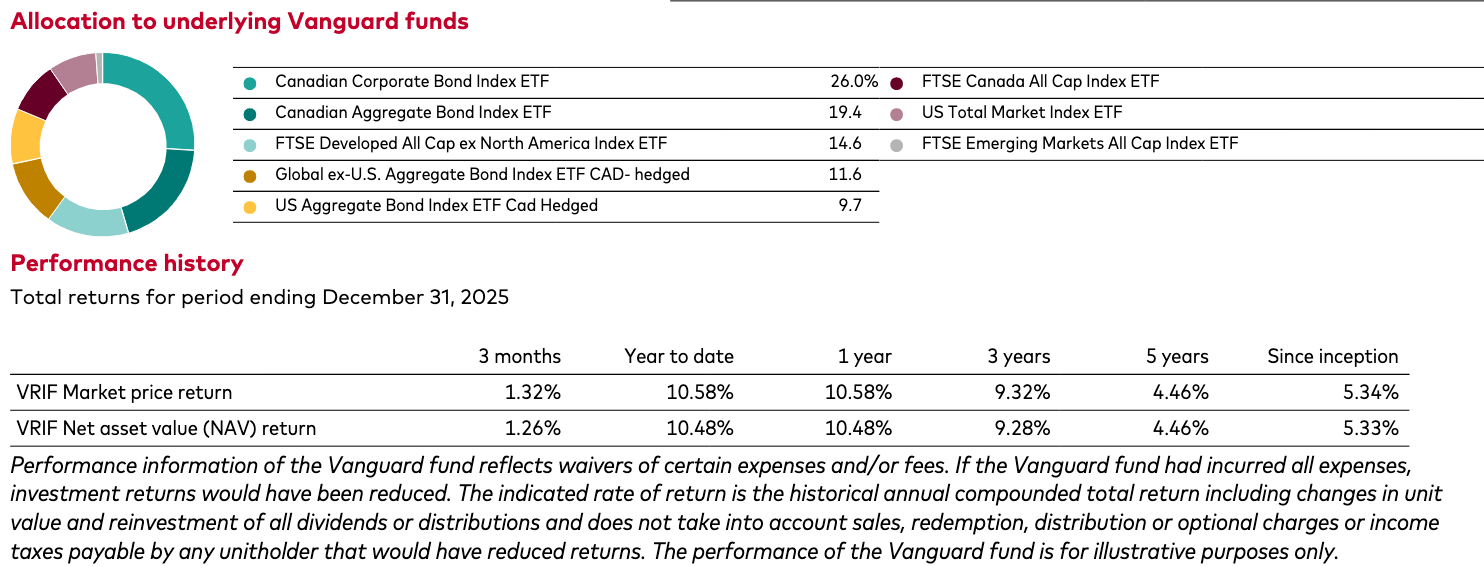
The screenshot below from Vanguard’s brochure shows VRIF’s holdings of Vanguard ETFs and performance to the end of 2025.


I first started a position in VRIF soon after its launch in 2020.  At the time, its Asset Allocation seemed to be around 50% stocks to 50% bonds, spread around all geographies in the normal proportions.

However, as 2025 proceeded I noticed that VRIF had begun steadily to cut back on its equity exposure and raise its Fixed Income, almost to the point of 30/70.  I’ve also noticed various YouTube videos from Vanguard’s U.S. parent that suggest similar caution: a cutting back from the big US growth mega cap stocks and a move more to other developed and emerging economies around the world.

If you read the VRIF launch news release, it emphasizes the objective is to provide income-seeking investors with a “targeted 4% annual payout.” That happens to be in line with William Bengen’s famous 4% Rule, which is “fine with me,” as I quipped at the media briefing.

In response to my query, Vanguard Canada spokesman Matthew Gierasimczuk said VRIF’s asset allocation varies over time” but the goal is the targeted 4% Return: Vanguard sees a “more optimistic outlook on bonds and Fixed Income: better to lock in without risk of equities.”

Kevin Khang, Vanguard

Then Kevin Khang, Vanguard’s head of global economic research  [pictured left] reiterated that the ETF seeks to fund a “certain level of payout: bonds in our view can achieve the desired certain level of payout” and “the US stock market is pretty expensive for obvious reasons: the US is reasonably valued and bonds are very normally valued; which is a new thing.” From 2009 to  2022, since the Great Financial Crisis, bonds in general didn’t pay much, which upset people in 2022-223 when rates went up but now they are reasonably valued: relative to inflation they are paying a decent Real Return.”

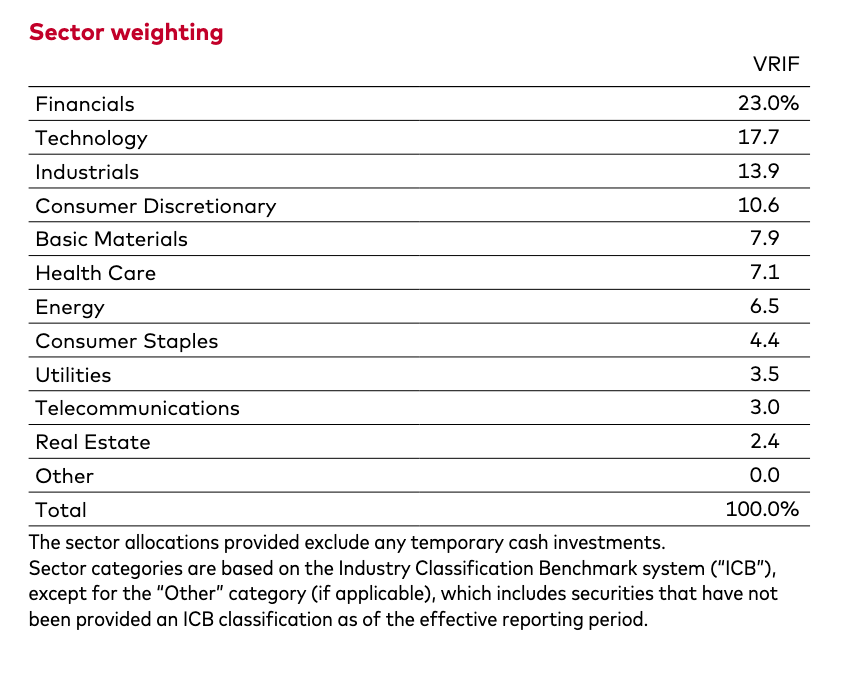
Here’s the sector weightings for VRIF at the end of 2025:

Vanguard rates its volatility as “low.” Notice the weightings of certain sectors often overweighted in pure low-volatility ETFs (like those from BMO and Harvest): Health Care, Consumer Staples and Utilities. As you can see above, the weightings in more volatile sectors like Technology and Financials is much higher.

For the MoneySense column I was subsequently referred to Head of Product for Vanguard Canada, Aime Bwakira. The rationale for VRIF’s high fixed-income exposure appears to be one of not taking more risk than you need to take, a stance which is apt for the retirees VRIF caters to. Bwakira confirmed Vanguard “has been leaning more heavily toward bonds — particularly higher quality and corporate bonds — than in past years while staying within its equity guardrails” of a minimum 30% and maximum 60%.  This positioning “reflects the current environment and the results of our capital markets projections.”

3 reasons Vanguard is boosting Fixed Income in VRIF

The rationale is three-fold:

First is higher interest rates. Bonds — especially corporate bonds — are paying more than they did for many years post the 20008 Great Financial Crisis (GFC): “This makes them well‑suited to support VRIF’s 4% income target without taking on unnecessary stock-market risk. VRIF includes corporate bond exposure specifically to help enhance yield for investors.

Second, given today’s market outlook, the fund’s model has shifted toward fixed income because bonds “currently provide a more favourable balance of expected return and risk.”  I was also referred to  Vanguard’s current VCMM 10-year projections (VCMM = Vanguard Capital Markets Model) for various asset classes. It’s also published in the US for US investors Vanguard Capital Markets Model® forecasts | Vanguard.

Dated January 22, 2026, the document states that “Even at current stretched valuations, rising earnings growth could provide momentum for stocks in the near term. However, our conviction is growing stronger that long-term prospects for U.S. equities are subdued. Our model anticipates annualized returns of about 3.9% to 5.9% over the next 10 years.” It adds that “Our muted long-term return projection for U.S. equities is entirely consistent with our more bullish prospects for an AI-led U.S. economic boom.”

The third and most important point raised by Bwakira is that “a higher allocation to bonds helps VRIF deliver reliable cash flows, which is central to its mandate. Because income needs don’t disappear during market volatility, VRIF prioritizes stability and sustainability in its payout. VRIF aims to maintain the value of an investor’s initial investment over the long term. Tilting toward bonds during periods of elevated equity market uncertainty helps protect investors from large drawdowns while still supporting the payout.”

VRIF is one popular source of Retiree income at the new Retirement Club

This common-sense caution has not gone unnoticed by Canadian retirees seeking stable income. VRIF is a well-regarded ETF members of the Retirement Club, founded by Cutthecrapinvesting blogger Dale Roberts and partner Brent Schmidt. One of the club’s monthly Zoom presentations in the autumn of 2025 highlighted VRIF among several other income sources for retirees. Roberts has long championed VRIF, as in this blog on his site originally written after the launch, and subsequently updated: most recently in this version. Continue Reading…

Are your “Diversified” ETFs actually Concentrated ?

By Erin Allen, CIM, BMO ETFs

(Sponsor Blog)

For the most part, when searching for a passive index ETF, you’ll typically encounter products that are weighted by market capitalization. In a market-cap-weighted ETF, a company’s size (calculated by multiplying its share price by the number of outstanding shares) determines how much influence it holds within the index1.

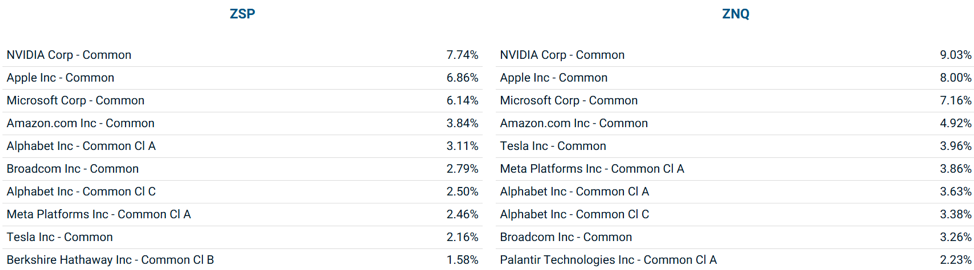
You can see this clearly in widely held U.S. equity ETFs. Take BMO S&P 500 Index ETF (ZSP) as an example. After accounting for the top 10 holdings, the remaining 490 companies make up about 59.49% of the portfolio. That means the top 10 stocks alone represent roughly 40.51% of the ETF’s total weight2.

The concentration becomes even more pronounced in indices like the Nasdaq 100 or the BMO NASDAQ 100 Equity Index ETF (ZNQ) which already has a reputation for heavy exposure to technology companies. In that case, the remaining 90 stocks together account for only 48.58% of the index, while the top 10 holdings make up over half of the entire portfolio3.

Chart 1 Compares top holdings of ZSP – BMO S&P 500 Index ETF to ZNQ – BMO NASDAQ 100 Equity Index ETF

Source: BMO Global Asset Management as of January 30, 20264

Supporters of market-cap weighting say it allows winners to keep running. As a company grows and becomes more valuable, it naturally takes up more space in the index. Over long periods, this approach has benefited from the success of dominant firms that continue to compound.

At the same time, that same feature can make some investors uncomfortable. In the context of 2026, buying a broad market ETF can effectively mean committing a large share of your capital to a relatively small group of mega-cap stocks that are trading at expensive valuations.

Fortunately, the choice is not limited to market-cap weighting or sitting in cash. Equal-weight strategies offer a different way to construct an ETF. Instead of assigning weight based on size, equal-weight ETFs give each constituent the same allocation, regardless of how large or small the company is.

Understanding how these two approaches differ, along with their respective advantages and limitations, is key to choosing the structure that best fits your goals.

How Equal-Weight ETFs work

To see how equal weighting works in practice, it helps to look at a concrete example. Rather than staying in the U.S. market, consider the Canadian utilities sector and compare two different index construction methods applied to the same group of stocks.

A common benchmark is the S&P/TSX Capped Utilities Index. This index tracks 14 Canadian utility companies and weights them by market capitalization, subject to a 25% cap on any single holding.

As of January 31, 2026 the four largest holdings dominated the portfolio. Fortis accounted for 23.35% of the index. Brookfield Infrastructure Partners made up 14.47%. Emera represented 12.61%, and Hydro One came in at 10.84%. Together, those four companies made up more than 60% of the entire index.

Utilities are often viewed as defensive businesses with sensitivity to interest rates and stable cash flows. But instead of making a sector-wide allocation, most of the portfolio’s risk and return ends up tied to a small handful of companies.

An equal-weight approach produces a very different result. The Solactive Equal Weight Canadian Utilities Index holds a similar group of utility stocks, but each company is given the same weight at each rebalance. With 13 holdings, BMO Equal Weight Utilities Index ETF (ZUT)5 allocates roughly 7.7% to each stock, regardless of company size5.

The practical effect is a more balanced exposure across the sector. Smaller or mid-sized utilities receive the same attention as the largest incumbents, and portfolio outcomes are less dependent on the performance of one or two dominant names.

Equal-Weighting for U.S. Stocks

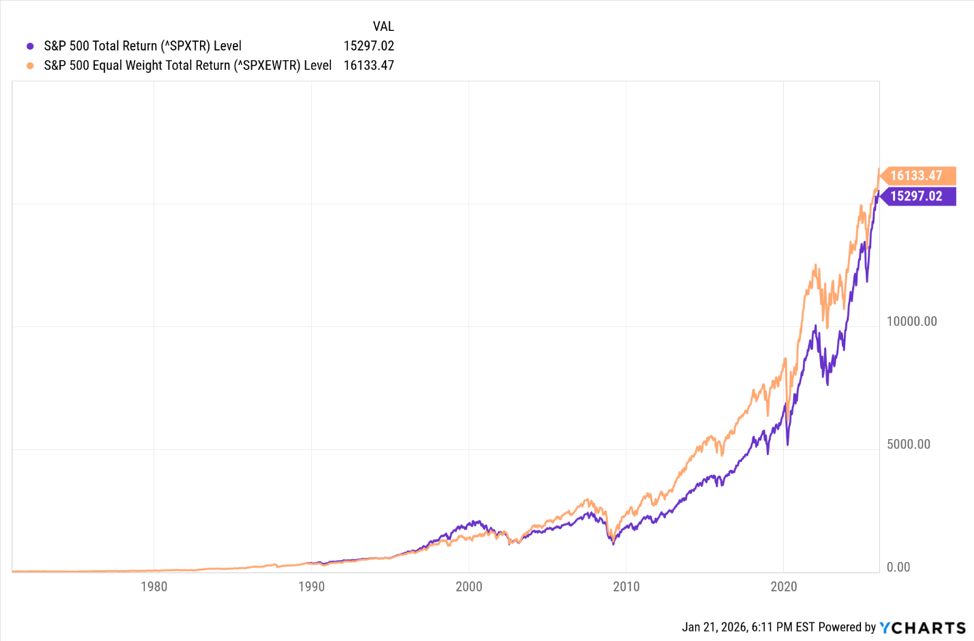
Equal weighting is not limited to Canadian sector ETFs. Entire equity markets can be constructed this way, including the U.S. market. There is a long history of data comparing the S&P 500 Total Return Index with its equal-weight counterpart – the S&P 500 Equal Weight Total Return Index .

Chart 2: Comparing the S&P 500 Total Return Index vs the S&P 500 Equal Weight Total Return Index.

Source: YCharts, as of January 21, 20266 Index returns do not reflect transactions costs or the deduction of other fees and expenses and it is not possible to invest directly in an Index. Past performance is not indicative of future results

Over time, both versions have gone through periods of outperformance and underperformance relative to each other. But from the start of the available data through today, the equal-weight version has delivered higher cumulative returns.
That outperformance tends to show up during periods when smaller and mid-sized stocks outperform large caps.

On the downside, they are also less exposed to drawdowns driven by a small group of very large stocks at the top of the index. However, equal weighting does not have to mean owning a modified version of the S&P 500. Canadian investors also have access to broader U.S. market solutions.

One example is the BMO MSCI USA Equal Weight Index ETF – ZEQL. This ETF tracks an index that includes the same companies as the MSCI USA Index, but weights them equally rather than by market capitalization. At each quarterly rebalance, every stock is reset to the same allocation. The practical effect, generally speaking, results in higher yield and lower valuations.

Chart 3: MSCI USA Equal Weighted Index (USD) Index Performance and Fundamentals

Source: MSCI as of December 31, 2025 7  Index returns do not reflect transactions costs or the deduction of other fees and expenses and it is not possible to invest directly in an Index. Past performance is not indicative of future results.

Continue Reading…