Evidence over emotion. Process over prediction. Better decisions over better guesses.
Most financial decisions eventually tell you how they turned out. Choosing your executor never will.
You will not be there to see whether the person you named handled it competently, whether your children are still speaking to one another afterward, or whether the estate settled in eight months, three years or longer.
As I wrote in the first article in this series we judge decisions by their results almost automatically. Here no result is available to judge. The reasoning is the only thing you will ever have, which is a good argument for doing it properly.
What would have to be true for your choice to work?
Most people name an executor the way they would hand out an honour. The oldest child. The sibling who is good with money. The person who would be hurt to be passed over.
A better test is the one this series keeps returning to. What would have to be true for this person to be the right choice?
Three things. They need the time. They need the temperament to hold a position under pressure from people they love. And they need the willingness to pay for professional help rather than guess. Most executors are appointed without anyone testing a single one of those conditions.
How much time does being an executor take?
Estate practitioners commonly estimate 100 to more than 400 hours, spread over twelve to thirty-six months or sometimes longer. Treat that as practitioner judgment rather than a measured Canadian average, because no reliable average exists. At the upper end, 400 hours is ten full working weeks to fit around a job and a family, often while grieving.
The value of the estate tells you less than you would expect. An organised portfolio can be easier to administer than a modest estate with awkward complications. A family member or other beneficiary may need to be located if you have lost contact with them. One living outside Canada brings legal, tax, currency, and cross-border considerations. Property abroad may require local legal and real estate expertise. Complexity comes from family circumstances and where assets sit, not from the size of the balance.
The unpredictable demands are harder still. One beneficiary wants the cottage sold, another wants to keep it, and your executor referees while explaining why nobody is being paid as quickly as they expected.
Can an executor be personally liable?
Yes, and this is the part most people never hear before they agree.
If an executor distributes estate assets without obtaining a clearance certificate from the Canada Revenue Agency, and tax remains owing, the executor can be personally liable up to the value of what was distributed. That includes amounts assessed after the money is gone. CRA does permit distributions before a certificate is issued if enough property is held back to cover the liability, so an executor needs advice on how much to retain.
Picture explaining to your siblings that part of their inheritance has to wait, even though the investments are sold and the cash is sitting in the account. From where they stand there is no visible reason for the delay. Your executor confirms the estate’s tax position anyway, and absorbs the resentment while doing it.
This is why temperament matters as much as financial knowledge. The person needs to be comfortable keeping records, explaining decisions, and saying no to people who will not enjoy hearing it.
Is your executor paid for this work?
They are entitled to be, and that is worth knowing before you compare options.
Ontario uses a long-standing guideline of 2.5 per cent of capital receipts and 2.5 per cent of capital disbursements, with the same rates on revenue in and out, plus a care and management fee of up to 0.4 per cent per year on the average value of the estate. Add those together and you arrive at the rough five per cent of estate value that people usually quote.
It is a guideline, not an entitlement. Courts assess what is reasonable against the size of the estate, its complexity, the time and skill required, the results achieved, and the responsibility assumed, and they can award less. A family member may waive compensation. Many do not, and they are not wrong to claim it, because the work is real.
Estate administration tax, still widely called probate fees, belongs in the same conversation. In Ontario there is nothing payable on the first fifty thousand dollars, and roughly 1.5 per cent on the value above that. It drives both the cost of settling your estate and the timeline your executor will be defending to impatient beneficiaries.
Should you appoint a professional?
It is a reasonable option, particularly where wealth is passing to the next generation, and interest in it has been growing.
There is more than one way to do it. A trust company can be appointed executor outright. Firms also act as agents, handling the administrative work while a family member stays the named executor, which keeps your family in control of decisions while removing most of the paperwork.
Be clear eyed about cost. Fees are generally a percentage of the estate and can look startling next to a family member doing it for nothing. The honest comparison is fee against fee rather than fee against free, since a family executor is entitled to compensation too. What you are buying is experience, fewer expensive mistakes, and someone absorbing conflict that would otherwise land on your children. Pricing and scope differ meaningfully, so compare before committing.
What about your power of attorney for property?
The person you appoint under a power of attorney for property manages your financial affairs during your lifetime, and that authority ends when you die. An executor deals with your estate afterward.
The same person may suit both roles, but assess them separately. Managing bills, investments, and care costs can mean years of continuous decisions. Someone willing to settle your estate may not have capacity for that.
Is there an estate decision where you do see the result?
One, and it deserves more attention than it gets.
If you have wealth beyond your own lifetime needs, giving during your lifetime is a real alternative to leaving a larger estate. Once affordability and the tax position are worked through, money given while you are alive arrives when the people receiving it can actually use it, rather than decades later when they may not need it at all. Continue Reading…
Hamilton ETFs recently hosted renowned Wall Street strategist Ed Yardeni in Toronto for a discussion on his outlook for markets, the economy and the risks facing investors.
With more than 40 years of experience forecasting economic and market trends, Yardeni has built an impressive track record, perhaps most notably for his “Roaring 2020s” thesis, which he introduced in August 2020.
From his updated 2020s forecast to the return of the bond vigilantes, here are six of the most interesting takeaways from the conversation:
Roaring 2020s Case lowered to 70% Probability
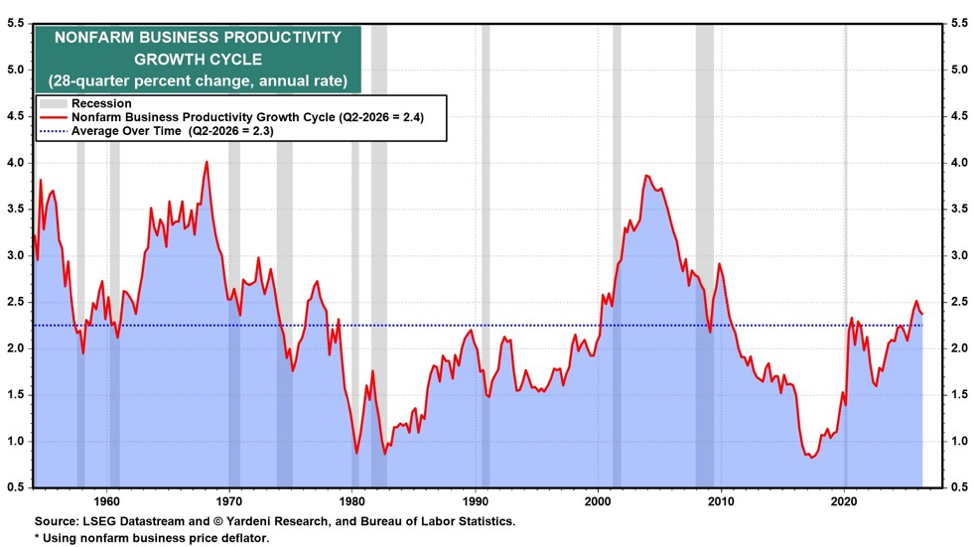
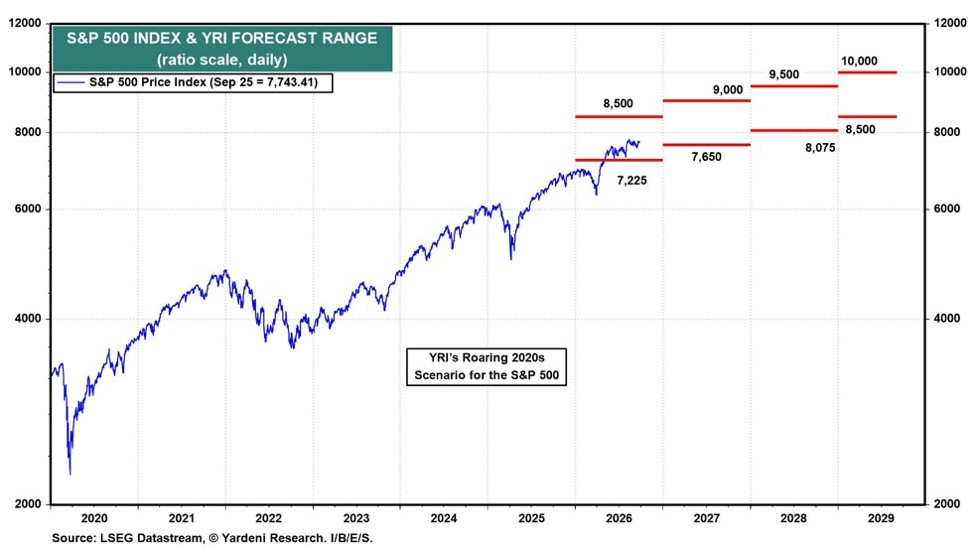
Ed Yardeni’s base-case Roaring 2020s scenario draws parallels between the 1920s and 2020s (both began with pandemics, recessions and pessimistic outlooks and saw great economic prosperity). He predicts technology-driven productivity gains will drive economic growth throughout this decade, which will end without a recession and the S&P 500 index at 10,000.
With just over three years left to go in the decade, he has lowered the odds of his Roaring 2020s scenario from 80% to 70%, raising the probability of a bearish outcome from 20% to 30%. He also lowered his S&P 500 target for the end of 2026 to 7,900 from 8,400 and moved his 8,400 target to mid-2027.
The main risk has shifted from the war in the Middle East and rising oil prices to rising bond yields and their potential impact on price-to-earnings (P/E) multiples. He cited the bear market in 2022 as an example of how falling multiples can drive shares lower even when earnings hold up.
Nevertheless, he sees stocks as long-term investments and pullbacks, corrections and even bear markets as potential buying opportunities.
Quote: “This Roaring 2020s story is basically productivity based. Productivity-led economic growth keeps inflation down, boosts margins, and actually boosts real wages. Wages rise faster than prices when productivity is moving.”
Reasons for Bullishness
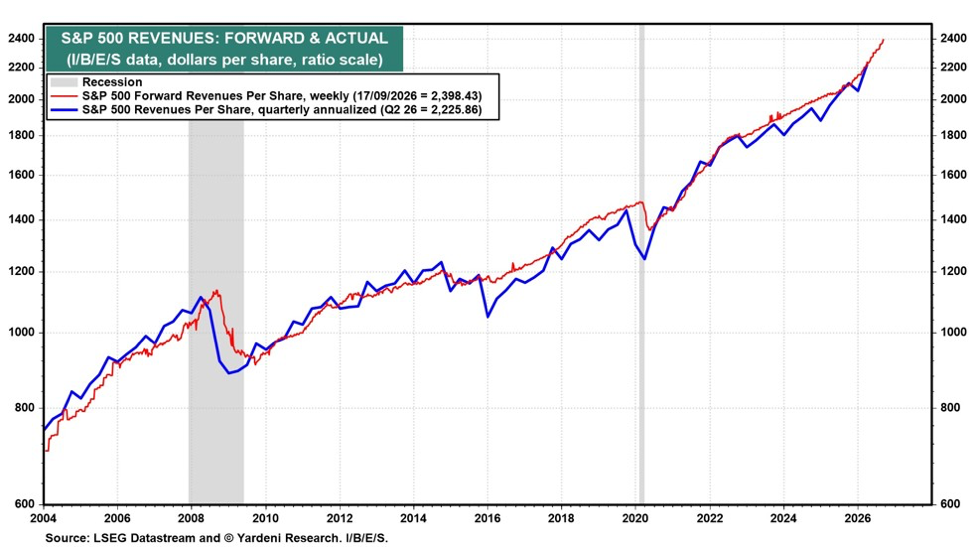
Yardeni believes the current bull market is being driven by “FEMO” (Fabulous Earnings Momentum) not “FOMO” (Fear of Missing Out) and points to rising analyst consensus expectations (see chart below) and the Q2 2026 earnings year-over-year growth rate being around 25% even after excluding unrealized gains on equity investments held by Big Tech.
He says if the U.S. economy is resilient, earnings will be resilient, and the economy has shown resilience in the face of several shocks (the pandemic, supply chain disruptions, inflation, Fed rate hikes, war, high oil prices etc.). The reasons for this are mainly strong consumer and capital spending.
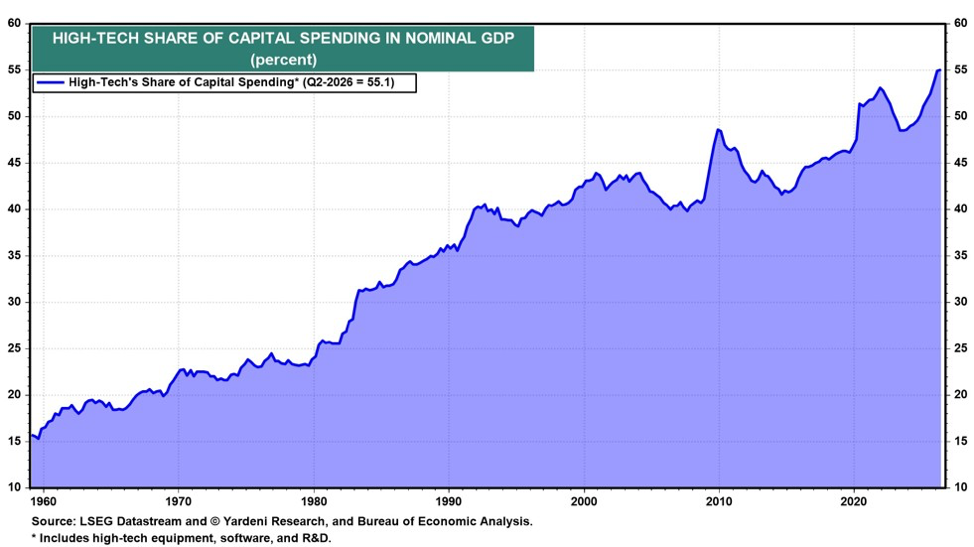
Although consumer confidence has taken a dive, this weakness isn’t reflected in retail sales. He says consumer spending is supported by the retiring baby boomer generation spending from their record net worth. Capital spending is supported by the AI boom. (see chart below).
He also acknowledged the U.S. economy’s resilience has been in part due to significant fiscal stimulus. This is a weakness in his bullish argument.
Revenge of the Bond Vigilantes: How High is Too High? Is it Time to Buy?
Yardeni, who coined the term “bond vigilantes” in 1983, said their influence was suppressed during years of quantitative easing and zero interest rates that kept yields low. They may return for “revenge” as bond markets operate more freely and interest rates get back to normal, demanding higher yields in response to the large government debts.
He sees several forces pushing yields higher globally, including government deficits, tightening monetary policies, inflation, strong economic growth and the unwinding of the yen carry trade. He’s watching the Bank of Japan’s actions closely as it faces pressure to strengthen the yen by raising interest rates, which in turn impacts bond markets. Continue Reading…
A Canadian equity ETF, a dividend ETF and a few bank stocks. That sounds like a bit of variety, doesn’t it? Open the funds’ holdings lists, though, and you may find you’ve bought the same company three ways.
Before adding another fund to a retirement portfolio, I like to answer one basic question first: how much of this company is already in there?
Start with your accounts
Decide which accounts go into the math. If your savings are spread across an RRSP, a TFSA and a non-registered account, looking at just one can hide part of the picture. This discussion of home-country bias makes the case for treating your accounts as one portfolio.
Use current market values, put everything in one currency and include your cash. That total is the number you’ll divide by.
One easy mistake to avoid: the stocks inside your funds are already counted in the funds’ value. Add them again and you’ve double-counted the same dollars.
Follow one company through your funds
Here’s a hypothetical C$100,000 portfolio: C$40,000 in the iShares S&P/TSX 60 Index ETF (XIU), C$20,000 in the iShares Canadian Select Dividend Index ETF (XDV), C$5,000 in Royal Bank of Canada shares and C$35,000 in cash. Treat these as market values on the holdings date below. This is an arithmetic example, not a suggested retirement allocation.
XIU tracks a large-company Canadian index, while XDV focuses on Canadian dividend payers. The funds have different mandates, but both hold Royal Bank.
BlackRock’s holdings files dated Oct 5, 2026 put Royal Bank at 9.48% of XIU and 8.61% of XDV. Multiply each fund’s value by that weight:
XIU: C$40,000 × 9.48% = C$3,792
XDV: C$20,000 × 8.61% = C$1,722
Direct Royal Bank shares: C$5,000
Add those up and you’ve got an estimated C$10,514 of exposure to Royal Bank shares. Divide by the C$100,000 total and that’s about 10.5% of the portfolio.
So that 5% in direct shares is only part of the story. Include the funds and your exposure more than doubles.
Tempted to add 9.48% and 8.61%? I’d put the calculator down for a second. Each percentage has to be scaled by how much you actually have in that fund.
What the number tells you
Finding overlap doesn’t mean you’ve made a mistake. You may want that exposure. I’d just rather discover the total while reviewing the portfolio than after that company has a rough week. Continue Reading…
One of the more interesting things I’ve learned from speaking with Canadians about retirement is that saving enough money is only half the battle. After spending 30 or 40 years accumulating investments, paying down mortgages, and generally trying to make responsible financial decisions, many people discover that actually spending their savings is more complicated than they expected.
After all, the financial rules that served you well during your working years don’t necessarily apply once the paycheques stop. Suddenly you’re juggling RRIF withdrawals, CPP and OAS decisions, investment income, tax brackets, and the possibility that your retirement could last another 30 years. Throw in the psychological adjustment of watching your investment accounts decline rather than grow, and it’s easy to see why retirement planning involves a lot more than reaching a magic number.
These are precisely the kinds of conversations I wanted to explore at this year’s Canadian Financial Summit, taking place online from October 21–24, 2026.
We’ve brought together more than 40 Canadian financial experts, with a particularly strong emphasis this year on retirement income, investment portfolios, tax efficiency, and making the transition from financial accumulation to financial independence.
The entire event is FREE to attend, with each presentation available to watch for 48 hours after its release.
What happens after you reach Financial Independence?
I was obviously pleased that Financial Independence Hub founder Jonathan Chevreau agreed to join us again this year. Jon has spent decades writing about financial independence, semi-retirement, pensions, investing, and the challenges of turning accumulated wealth into retirement income.
This year, however, we’re approaching the subject from a slightly different angle. Having made the transition from writing about retirement to experiencing it himself, Jon is sharing his perspective on what he got right, what surprised him, and what he might approach differently with the benefit of hindsight.
His session, From Retirement Columnist to Retiree: What I Got Right, Wrong, and Didn’t Expect, goes beyond the financial calculations to examine the actual experience of leaving employment behind. We’ll discuss the move from earning a paycheque to drawing on investments, the temptation to postpone spending, and why financial independence doesn’t automatically eliminate financial anxiety.
I suspect many readers here will find his observations especially interesting. After all, there aren’t many people who have spent as much time as Jon studying the theory of financial independence before testing it in their own lives.
Retirement Income & Taxes
Another major focus this year is what financial planners call decumulation: the process of converting your investments and other assets into money you can actually live on.
The challenge is that Canadians have several different sources of retirement income, each with its own tax treatment, withdrawal rules, and planning opportunities. Getting the sequence right can make a substantial difference over the course of retirement.
Here are some of the presentations I’m particularly looking forward to:
Robb Engen: What retirement spending and taxes actually look like, including the confusion surrounding RRSP withholding taxes and how retirees establish a sustainable withdrawal routine.
Nancy Grouni and Ed Rempel: Reducing lifetime retirement taxes, coordinating RRSP/RRIF withdrawals with CPP and OAS, and avoiding expensive tax surprises.
Dale Roberts: Building a retirement cash flow plan that connects your investments, government pensions, tax brackets, and spending needs.
James Gauthier: Adjusting your investment portfolio for retirement, with particular attention to sequence-of-returns risk and balancing growth with reliable income.
Isabelle Bernier and Mike Heroux: Why Canadians who have saved diligently for decades sometimes struggle to spend their money, and how to balance financial security with actually enjoying retirement.
Mark Seed and Kornel Szrejber: Firsthand perspectives on achieving financial independence, leaving traditional employment, and discovering what life looks like after reaching your savings goals.
We’ve also invited Jason Heath to explain how to evaluate the assumptions underlying professional financial plans, while Hannah McVean will demonstrate a step-by-step Canadian financial planning case study. Both sessions should be useful for anyone who wants to better understand the calculations behind their retirement projections.
Retirement Planning is about more than Investment Returns
One theme that runs through many of this year’s conversations is that the best retirement strategy isn’t necessarily the one that produces the highest possible net worth. Continue Reading…
Claiming Social Security early can provide immediate income, but it may reduce future benefits and limit financial flexibility. This article examines key factors such as debt, longevity, cash reserves, survivor protection, and income planning.
Insights from financial experts help readers compare options and make more informed timing decisions.
Preserve Flexibility amid Program Uncertainty
It depends on life stage. Younger clients may want to plan for 75% of benefits on the dollar. While scenarios for pre-retirees can range from reduced benefits to a flat non-inflation-adjusted benefit.
The decision making math remains the same. It’s still too early to tell exactly what will happen with Social Security. Pre-retirees should still consider income needs and longevity over how benefits might change.
To hedge this risk pre-retirees should build flexibility within their retirement plan. Locking income into guaranteed lifetime payments makes it harder to pivot if benefits change. — Samuel Resultan, Financial Consultant, Voyage Wealth Management
Postpone CPP and OAS for Raises
For Canadians who can keep working — or who have other income to bridge the gap — delaying CPP and OAS is one of the few guaranteed raises in retirement. According to Service Canada, CPP grows 0.7% for every month you delay after 65, up to 42% more at 70, and OAS grows 0.6% a month, up to 36% more at 70. Those larger payments are permanent and indexed to inflation, so delaying is really buying longevity insurance: the longer you live, the more it pays. It is not right for everyone. If you need the income now, have health concerns, or qualify for the Guaranteed Income Supplement, starting earlier can make sense. But if you are healthy, still working, and can cover expenses in your late 60s from savings or part-time income, run the numbers on waiting before you default to 65: 65 is just the standard age, not a deadline. — Rohit Dahiya, Founder, LearnLoonie.ca
Keep Cash Reserves for Deferral
The national debt and the Social Security trust fund get lumped together, and they’re separate problems. The trust fund is what matters here. The trustees project it runs short in the early 2030s, and after that incoming payroll taxes still cover roughly 80 per cent of scheduled benefits. That’s a cut. It isn’t zero.
So run the numbers with the cut baked in. If waiting to 70 still wins at 80 cents on the dollar, and for a healthy married person it usually does, the headline doesn’t change the answer. If a cut comes it would most likely be across the board, which means the person who claimed at 62 takes it on a check that was already about 43% smaller than the age-70 amount.
Claiming early does make sense with poor health, or for the lower earner in a couple whose check won’t become the survivor benefit. Taking it early to invest only works if it actually gets invested. In my experience it usually gets spent.
The better hedge is a cash reserve, so you’re never forced to claim early in a bad year. — Hans Goldstein, Founder, Structured Installment Sales & Exit Tax Planning, Hans Goldstein: Tax & Exit Planning
Stress-Test Income and Build Reserves
My numbers don’t change much. The US$40 trillion national debt is a separate problem from the Social Security trust fund shortfall. The biggest risk to me is that the retirement fund will be exhausted by 2033, at which time about 77% to 80% of scheduled benefits will continue to be paid from current payroll taxes. Any cut to benefits will be proportional, so that a reduced cheque at age 70 is still larger than a reduced cheque at age 62. For Canadians, the biggest risk to the plan is zero. But the CPP is a separately funded plan, and the chief actuary reports that it will be “sustainable” for 75 years.
There is some justification to taking your retirement benefits early, but the reward for waiting past full retirement age to take benefits is significant. Generally, one can earn 8% per year more in guaranteed, inflation-adjusted income by delaying retirement benefits past full retirement age. Waiting to take retirement benefits early is therefore justified by poor health, short family longevity, or no spouse to receive survivor benefits.
Calculate how much you need to have to run the plan at 75% of your projected benefit. If the number is still sustainable, then the rest of the news is irrelevant. Use your 401(k) or RRSP to “bridge” to 70. The effect of lowering your required withdrawals and taxes in retirement will be dramatic. Keep 2-3 years of required retirement spending in cash or very short-term bonds. The worst crash ever will not force you into early retirement. Pay off your mortgage before retirement. The worst fixed cost in retirement is yourself. — Ace Zhuo, CEO | Sales and Marketing, Tech & Finance Expert, TradingFXVPS
Let Longevity guide your Timing
Myth: Since the trust fund is running short anyway, I should “take it early and grow it.”
Social Security claiming age has little to do with markets or investment-return guesses, and a lot to do with longevity and breakeven. Will you, or a spouse who may rely on survivor benefits, live long enough for the delayed retirement credits (the increase you earn by waiting past full retirement age, up to 70) to outweigh the permanent reduction for claiming between 62 and full retirement age? That math does not need an investment-return assumption.
Trust fund shortfall talk changes the risk story, not the formula. According to the SSA trustees, if Congress takes no action, scheduled benefits can be paid until the OASI reserve is used up. After that, ongoing payroll tax revenue covers only a portion of scheduled benefits, and that cut applies to everyone, not just those who delay. So claiming earlier does not create a protected pocket outside the same rules.
Instead of “take it early and grow it,” model these:
Your primary insurance amount at full retirement age, then the reduction or delayed-credit bump at your claim age.
Spousal and survivor benefit interactions.
Taxes and Medicare: other income can make benefits taxable and affect IRMAA, and working before full retirement age can trigger the earnings test.
A cash-flow bridge if you delay, with a tax dry-run on withdrawals from other accounts.
Check your Social Security account often to keep your earnings record clean, and revisit your claiming age when health, work plans, or a spouse’s age changes. — Mehdi Zare CFA, Founder, Bina Capital
Clear Debt before you File
I’m Nick Avila, founder of United Debt Relief. I’ll leave the investment math to planners and add the part most claiming advice skips: your own debt.
First, the cut. The 2026 Social Security Trustees Report projects the combined trust funds will be depleted in 2034, with enough income at that point to pay 83% of scheduled benefits if Congress doesn’t act. That’s a real risk. It’s also a partial cut, not zero, and under current law it would apply to early and late claimers alike. So on its own, I think it’s a weak reason to lock in a permanently smaller check.
And the early-claiming penalty is permanent. For anyone born in 1960 or later, SSA says claiming at 62 pays 70% of your full benefit, and each year you wait past 67 adds 8% until 70.
Where I do see early claiming make sense is Debt. If someone reaches 62 carrying credit card balances, at the 22.15% average rate the Federal Reserve reports for accounts charged interest, and has no other way to pay them down, using early benefits to clear that debt can beat letting it compound for years while they wait. It’s an expensive fix, though. I’d much rather see people clear the cards from earned income in their late 50s and keep the option to delay.
The hedge I wish more people knew about is legal, not financial. The CFPB notes that when benefits arrive by direct deposit and a bank gets a garnishment order, two months of benefits are protected in the account, and Social Security is shielded from most private debt collectors. Government debts are different. Back taxes and defaulted federal student loans can be collected from benefits, and SSA says the IRS can levy up to 15% of payments for overdue federal taxes.
So the best hedge against a smaller cheque is entering retirement without federal tax debt or a defaulted federal student loan, because those can follow you straight into your Social Security payment. Everyone’s situation is different, so run your own numbers with a fee-only planner before you decide when to claim. — Nick Avila, Founder, United Debt Relief
Protect Survivors with Layered Coverage
We need to keep in mind that current warnings refer to reducing the benefits, not their elimination, and waiting to claim typically results in higher payments. Claiming early translates into a permanently lower benefit and introduces market risk, which may not outweigh the guaranteed increase from delaying.
While indeed this approach will work for some individuals, it should be reviewed with a licensed financial advisor case by case rather than applied broadly.
One critical factor families often overlook is the impact on the surviving spouse. After the higher-earning partner passes away, the survivor generally receives the larger Social Security payment. If the higher earner claims early, the surviving spouse may have to rely on a smaller benefit for many years.
Relying on a single income source is not advisable. In my 18 years in the insurance career, I have observed that retirees who feel most secure use multiple layers of protection, such as combining Social Security, savings, and life insurance designed to replace lost spousal income. When one income stream ends due to a spouse’s death, life insurance can help fill that gap, allowing the surviving spouse to remain in the home.
This is not an investment strategy per se, but a way to ensure that benefit reductions, market downturns, or loss of a spouse do not impact the same person all at once. — Jeremy Hewett, President and Chief Executive Officer, AccuQuote
Diversify Globally against Sovereign Risk
With over 20 years advising private equity and multinationals on capital advisory, I evaluate statutory retirement benefits through the lens of sovereign counterparty risk. When a public balance sheet faces severe long-term debt, relying entirely on static future payout models introduces regulatory uncertainty that you cannot control.
There is a sound strategic argument for claiming early if you systematically redirect that cash flow into liquid global equities and high-yield operational investments. Taking the liquidity immediately places capital allocation back under your direct governance rather than leaving it exposed to future legislative restructuring.
A strong hedge against single-country entitlement reform is geographic and jurisdictional diversification. By structuring assets across multiple international corporate entities and foreign-denominated holdings, you insulate your broader wealth plan from the fiscal pressures of any single government. –– Sebastien Gaddini, Principal, Corpiya
Delay Social Security despite Potential Haircuts
The $40 trillion debt headline is genuinely alarming, but let’s separate two distinct issues that often get conflated: the national debt is a real long-term fiscal challenge, while Social Security’s funding shortfall is a separate, more immediate, and more precisely quantifiable problem tied to payroll tax revenue versus benefit obligations, not general federal debt. The Trustees project trust fund depletion around 2033-2034, potentially triggering an automatic 20-25% benefit reduction if Congress takes zero action, which I consider unlikely but not impossible.
Does this change my calculation on delaying to 70? Not dramatically, and here’s the math explaining why. Delaying benefits still guarantees roughly 8% annual increases between full retirement age and 70. Even if benefits get reduced by 20-25% starting in 2034, that reduction would apply proportionally whether you claimed at 62, 67, or 70, since cuts would adjust the overall benefit formula, not penalize delayed claiming specifically. So delaying still produces a larger base benefit before any potential haircut, meaning you’d still come out ahead with delayed claiming even under reduction scenarios, just with a smaller total than originally projected.
The “take it early and invest for growth” argument does have some legitimate mathematical appeal, particularly if you’re disciplined enough to actually invest rather than spend the money, and if market returns cooperate. Historically, an 8-10% average stock market return could theoretically outpace the guaranteed 8% delayed retirement credit.
I recommend three approaches: first, build retirement income diversification beyond Social Security through IRAs, 401(k)s, and if available, guaranteed income products like annuities, reducing total dependence on any single income source. Second, maintain flexibility in your claiming strategy, some financial planners now recommend claiming slightly earlier than 70, perhaps at 67-68, splitting the difference between maximizing benefits and hedging against uncertainty. Third, stay politically engaged and informed, since historically Congress has always intervened before depletion deadlines through payroll tax adjustments or formula changes, meaning the doomsday scenario, while theoretically possible, remains historically improbable given the political consequences of inaction. — Loretta Kilday, DebtCC Spokesperson, Debt Consolidation Care
Model a Reduced Future before Claims
I would not treat the Social Security funding warning as an automatic reason to claim early. I would instead stress-test the retirement plan as though future benefits will be lower, then make the claiming decision based on longevity, cash needs, and risk tolerance. Continue Reading…


 Posted By